

AT&T Fiber vs. Frontier Fiber: Comparing Two Fiber Networks
Two 100% Fiber Networks, Two Different Footprints
AT&T Fiber and Frontier Fiber have a lot in common on paper — both run 100% fiber-optic lines straight to the home, both deliver symmetrical upload and download speeds, and neither locks you into an annual contract. Where they really differ is coverage: these two networks were built in largely separate territories, so for most readers this comparison is less “which is better” and more “which one, if either, actually reaches your address.”
Comparing AT&T for your own home? See current AT&T Fiber and Internet Air plans, pricing and deals and check availability at your address.
There’s also a recent wrinkle worth knowing about: Frontier is no longer an independent company. Verizon completed its acquisition of Frontier Communications in January 2026, and Frontier now operates as “Frontier, a Verizon Company.” That changes some of the bundle math below, even though day-to-day Frontier Fiber service hasn’t changed.
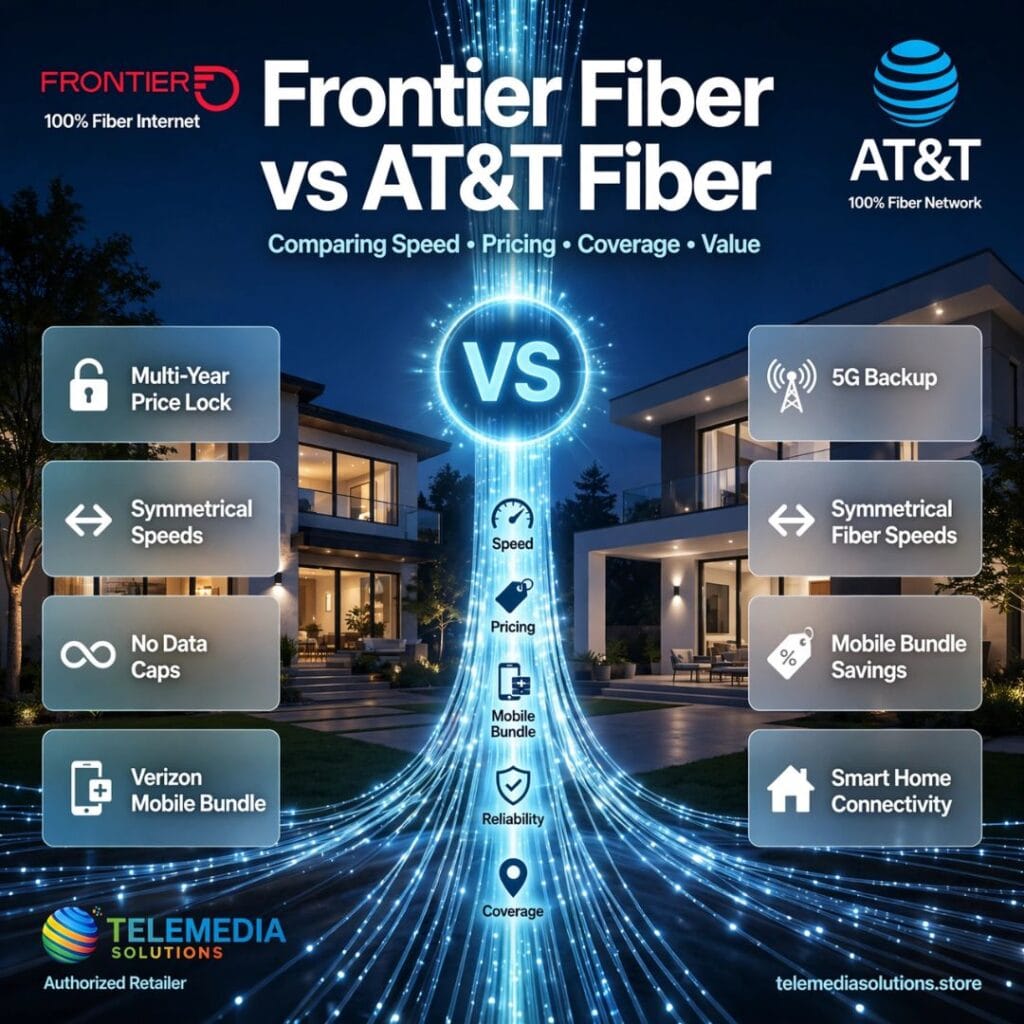
AT&T Fiber vs. Frontier Fiber: Side by Side
| Feature | AT&T Fiber | Frontier Fiber |
|---|---|---|
| Entry plan | 300 Mbps — $35/mo promo | Fiber 500 — $49.99/mo |
| Mid tier | 1 Gig — $50/mo promo | Fiber 1 Gig — $69.99/mo |
| Top tier | 5 Gig — $95/mo promo | Fiber 5 Gig — up to $124.99/mo |
| Upload speed | Symmetrical on every tier | Symmetrical on every tier |
| Contract | None — month-to-month | None — month-to-month |
| Price after year 1 | Reverts to standard rate (e.g. $35 → $60) | Locked 3-5 years depending on plan |
| Mobile bundle discount | 20% off with eligible AT&T Wireless plan | $15/mo off with eligible Verizon mobile plan |
| Data caps | None | None |
| Footprint | Parts of 27 states, mature buildout | 28 states, newer buildout, expanding under Verizon |
Promotional pricing on both sides applies for the first 12 months with AutoPay and paperless billing, then reverts or continues per each provider’s terms. Confirm the exact rate at checkout — pricing and availability vary by address.
Coverage: Where the Two Networks Actually Overlap
This is the part that matters most in practice. AT&T Fiber has the larger, more mature footprint of the two, concentrated in AT&T’s traditional local phone territories — parts of 27 states including Texas, California, Florida, Georgia, and much of the Southeast and Midwest. Frontier Fiber’s buildout is newer and still expanding, covering 28 states with a network that Frontier has spent recent years converting from old copper lines to all-fiber.
Because the two companies built out in largely separate legacy territories, direct address-level overlap between AT&T Fiber and Frontier Fiber is uncommon — most households will find one or the other available, not both. That’s actually useful information: it means this comparison is less about picking a favorite and more about confirming which network, if either, is actually built to your home.
One thing that could shift the picture over time: Frontier’s new parent company, Verizon, closed its acquisition in January 2026 and now operates a combined fiber network of nearly 30 million passings across 31 states between Frontier and Verizon Fios. That’s a larger combined footprint than Frontier had on its own, though it still doesn’t overlap much with AT&T’s core territory, since Fios and Frontier historically served different regions than AT&T.
Pricing: Close at Entry, AT&T Pulls Ahead at the Top
At the entry level, AT&T Fiber’s $35/mo promotional rate for 300 Mbps undercuts Frontier’s $49.99/mo Fiber 500 plan — though Frontier’s entry tier delivers more raw speed for the higher price. In the middle, AT&T’s 1 Gig promo pricing (currently matching its 500 Mbps rate at $50/mo) is a strong value if it holds at your address, beating Frontier’s $69.99/mo Fiber 1 Gig. At the top end, the two are close: AT&T’s 5 Gig tier runs $95/mo promotional versus Frontier’s 5 Gig at up to $124.99/mo.
The bigger difference shows up after year one. AT&T’s promotional pricing reverts to a higher standard rate once the 12-month discount period ends. Frontier’s price-lock guarantee, by contrast, holds your base rate for a stated multi-year term — 3 years on its entry tier, 5 years on 1 Gig and above — so the number you sign up at stays the number you pay for years, not just twelve months.
Which One Should You Choose?
- Choose AT&T Fiber if: it’s available at your address, you want the lowest possible starting price, you’re already an AT&T Wireless customer who can claim the 20% bundle discount, or you want the 5G failover feature that automatically keeps your home connected if the fiber line goes down.
- Choose Frontier Fiber if: it’s available at your address and you’d rather lock in a stable rate for 3-5 years than risk a price jump after the first year.
- In practice: most readers will only have one of the two available. Check coverage first — the pricing and bundle comparisons above only matter once you know which network actually reaches your home.
For the full breakdown of each provider’s lineup, see our AT&T Fiber plans and pricing guide or the Frontier Fiber plans and pricing breakdown. If you’re weighing a move to AT&T Fiber from a cable provider, see our guide to switching to AT&T Fiber.
Verify Independently: FCC Data & Consumer Tools
We’re an authorized retailer, not AT&T or Frontier/Verizon themselves — cross-check availability and pricing using independent government tools before you commit:
- FCC National Broadband Map — see which providers and speeds are reported at your address
- FCC Broadband Facts labels — standardized pricing and fee disclosures
- FCC Consumer Complaint Center — research or file complaints against any provider
Still weighing your options? See how this stacks up in our guide to the best internet providers in the USA.
How We Verified This
Pricing, plan, and availability details on this page were checked against the providers’ own published materials before publication, and are reviewed when they change. See how we research internet & TV providers, our editorial standards, and why consumers trust Telemedia Solutions.
Frequently Asked Questions
Is Frontier Fiber owned by AT&T?
No. Frontier Communications is a separate company from AT&T. As of January 2026, Frontier is owned by Verizon, not AT&T — the two brands have never been affiliated.
Can I get both AT&T Fiber and Frontier Fiber at my address?
It’s uncommon. The two networks were built in largely separate legacy territories, so most addresses will have access to one or neither, not both.
Which has faster speeds?
Both offer symmetrical fiber speeds up to 5 Gig at the top tier, and both scale down to similar entry-level speeds. Neither has a meaningful speed advantage over the other — the real differentiator is price structure and bundle eligibility.
Does the Verizon-Frontier merger affect current Frontier pricing?
Not directly. Frontier has stated current plan pricing isn’t changing as a result of the acquisition, though Frontier customers now have access to new Verizon-linked bundle discounts.
Does either provider offer TV service?
Neither bundles TV directly into its fiber internet plans. Frontier does not sell its own TV service at all. AT&T’s television offering is handled separately through DirecTV rather than bundled into AT&T Fiber the way it once was with U-verse.
Which has better mobile bundle savings?
AT&T’s 20% off for AT&T Wireless customers is a larger percentage discount than Frontier’s flat $15/mo off for Verizon mobile customers — but each only applies if you already carry that specific mobile provider.
Find Out What’s Actually Available at Your Address
Telemedia Solutions is an authorized AT&T retailer. Call us and we’ll check AT&T Fiber availability and current pricing for your exact address — no pressure, no guesswork.